Conceptualizing the Future and Considering the Candidates
And dissecting the language used- Workforce vs Working Classes

Reporting from the Boothbay Peninsula, Maine, USA
The other day, I drove by the affordable housing development on Butler Road. I was struck by the inappropriateness of its Tinkertoy-esque architectural style. The developer-commissioners who wrote the law included prohibitions on municipalities using criteria based on“overpopulation”, “overcrowding,” or “character of location”. The developers knew what they were doing and wanted to cut all opposition off at the pass.
Sec. 3. 5 MRSA §4581-A, sub-§5 is enacted to read: 30 5. Housing development. For any municipality or government entity to restrict the construction or development of housing accommodations in any area based upon criteria that refers to the character of a location, the overcrowding of land or the undue concentration of the population. For the purposes of this subsection, the following terms have the following meanings.
A. "Character of a location" means the unique characteristics of a municipality or specific area within a municipality or other political subdivision.
Making such restrictions on what municipalities may use as criteria very arguably violates the Home Rule Amendment of the Maine Constitution, which grants authority over matters local and municipal in character to the municipalities, which inarguably includes overcrowding, overpopulation, and character of location. Nonetheless, the unelected legislators were allowed by the elected legislators to write whatever suited their fancy into law, and no one questioned it.
The local oligarch gave his stamp of approval for the use of affordable housing dollars by making the first donation, and Town, County, and State leaders followed suit as they always do in a town and state where money talks louder than any other criteria.
The town, city, and state distributed affordable housing dollars to the newly formed Boothbay Regional Development Corporation without considering the people or the character of the location, as instructed by the law written by the developer-commissioners led by Erin Cooperrider, who thereafter became the VP of the newly formed Boothbay Regional Development Corporation.
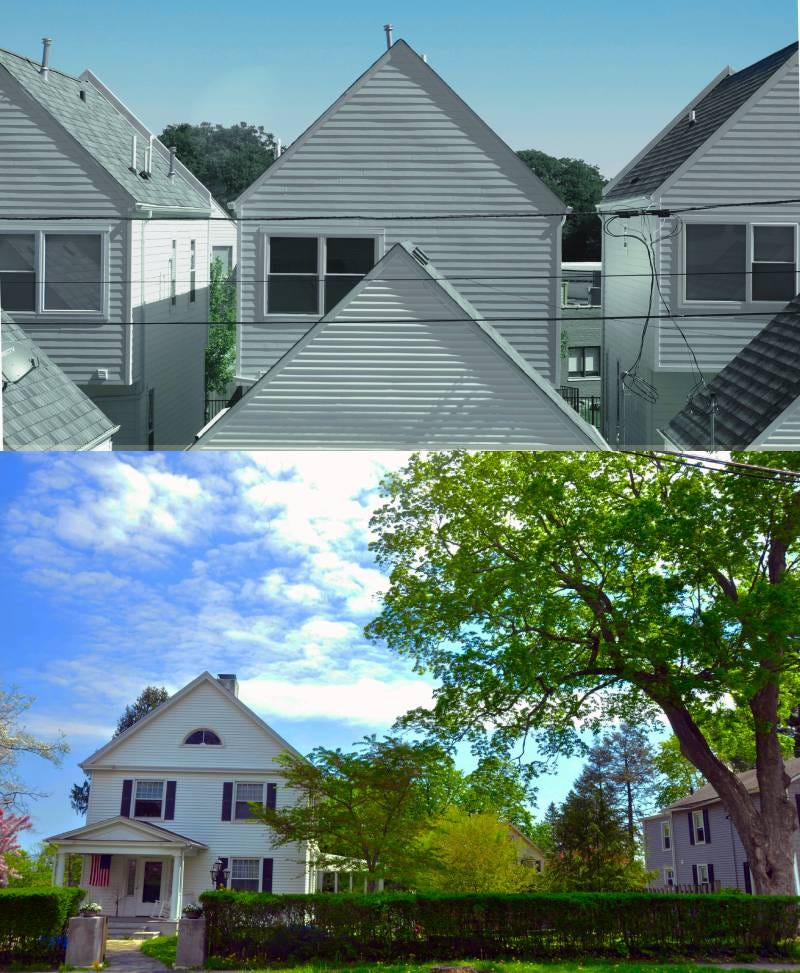
The TinkerToy Townhouses in corporate-owned landscaping are surrounded by traditional Maine homesteads on unique lots of land, speaking the message of a class society loudly and clearly, which is what you get when the consideration of the character of the location is prohibited.
The developers’ class got their way with the law, but not with the buyers, as the “units” have been on the market for 428 days without a sale. The units are successfully out of character with their surroundings, but the stark comparison does not work successfully in the developer’s marketing favor.
If we are going to censor speech, I suggest banning the branding of the working classes as “the workforce”. The term “workforce” is a thinly veiled cover for the “serfforce”, which Ms Cooperrider, the VP of the Boothbay Regional Development Corporation, imagines to have a more respectable connotation than “low-income”, and, more importantly, she also believes it will allow housing funded with affordable housing dollars to be sold and rented at a higher price.
The term “the workforce” is a static noun speaking the language of a singular object used as a bargaining instrument in negotiations between the state and private industrialists.
The term the working classes, is an active verb qualifying a multiplicity and variety of classes of people who work. It reflects a genuine respect for work.
“Workforce” condenses the voices of the working people into a voiceless object whose interests are decided by the institutions that barter between themselves for the good of the people, but never invite the people to be part of the conversation. The power elite knows what is best for the people; it is whatever is best for the power elite, so there is no need to engage the people in the conversation.
Ms Cooperrider, a leading commissioner who brought about the enactment of HP1489, planned the language long in advance, changing the terminology from “low-income” or “affordable” housing to “workforce housing”, which is what the Boothbay Peninsula got for its affordable housing dollars, but the imagined workforce isn’t there.
The overcrowded housing zone was initially planned in conjunction with the planned demolition and replacement of the high school to be reconfigured as an industrial job training center, requiring units to house the trainees efficiently, as planned by the Anonymous Investors and Bulldozers Group led by none other than the town’s leading oligarch, Paul Coulombe, who has a trail of projects behind him that are failing for various reasons.
But the industrial training school didn’t get built because the people of the Town were given a voice and they voted it down.
Workforce housing is covered, so now we can move on to housing for the working classes, which requires a variety of solutions to match the variety among the working classes. I have been advocating for one of those solutions, an economic development zone that accommodates businesses in or attached to the home.
I make the pitch in the local newspaper since I am systematically excluded from the institutional circuit. Now that I've made it, that’s all I can do. I am formulating another plan for the productivity assets that I am responsible for, one that casts a wider net, but more on that another time.
In local news, it is election season for Town selectmen and school board member positions.
For the school board, I like both Mike Bartles and Patty Minerech. (I wrote this before a long list of other candidates emerged) Both candidates say they will control spending, but Patty Minerich has a history of taking the lead with court actions against an out-of-control school board that operates as if it is above the law.
However, the lawsuit did not take on specific violations of the law regarding the statutory requirements for signatures needed for a reconsideration vote, and the quorum that must be equal to or higher than the size of the electorate in the original vote.
The school board met neither of these requirements, but no one called them on it, as if the law applies to every other citizen except those on the school board, but the law does not provide such an exemption.
Instead, the school board argued a violation of the invented prohibition against including a second question. Such a prohibition is not stated in the law, but thereafter the case was dismissed on a technicality. (The question was probably too specific in proposing an alternative referendum, but there is no prohibition in the statute about that either- will the Maine Legislature rewrite and clarify the statute, now that the Supreme Court has ruled on it before the fact?)
Defenders of the schools agressive actions berated Minerich for costing the school time and money. In so doing, they degraded citizens’ rights under the law.
The opponents of Minerich took up this ill-founded argument, which was adapted by Mike Bartles. I like Mike Bartles, but when you put it on those terms, I will go with Patty Minerich. Bartles comes across as kinder and gentler and possibly more creative, but that depends on how one measures creativity. I admire Patty Minerich for taking a leadership role in pursuing citizens’ rights under the law. I will root for anyone who goes out of their way and walks the extra mile for the cause of citizens’ rights.
That Minerich should be shamed and blamed for the insidious cause of money and power in the hands of the few, for the act of exercising her citizen rights and representing the will of the inhabitants of the community, as expressed in the original vote, falls far outside the realm of justice and equality for all.

I like Mike Bartles. Mike Bartles makes sails. He would make an excellent school board member as he seems to have great communication skills and a genuine interest in the nature of work. If there were a Museum of American Designer Craftsmen on the Peninsula, he would make an excellent board member, and the museum could be a teaching institution as well. If it were located in the TIFF zone, it would be in proximity to the Industrial Park, where it was recently announced that a shipbuilder is going into that location.
The Maine Constitution states that accepting state money for the public schools comes with relinquishing power over the local school system to the state:
Section 1. Legislature shall require towns to support public schools; duty of Legislature……..no donation, grant or endowment shall at any time be made by the Legislature to any literary institution now established, or which may hereafter be established, unless, at the time of making such endowment, the Legislature of the State shall have the right to grant any further powers to alter, limit or restrain any of the powers vested in any such literary institution, as shall be judged necessary to promote the best interests thereof
Therefore, if it is desired to maintain local control over the public school system, it requires a policy of not accepting state funding. This is easier to do if the school curriculum is kept within traditional parameters. It is the state that has expanded the public school curriculum to include industrial job training. Once funds are accepted by the public school system for that purpose, the local community loses control, and there is no telling how such programs will expand and increase the cost to taxpayers for financing the industrial job training of state or private industries.
If, instead, industrial job training is done at the Industrial Park or a Museum of Designer-Makers, state money could be accepted through those entities rather than the public educational system, providing acceptable terms, and hypothetically coordinated with the public educational system. This is only a concept- as they say, the devil is in the details, but it begins with a concept- the concept is to shift the training and the cost of the training back to the industrial sector where it belongs.
Then, if we have someone like Minerich on the school board keeping the costs down, with Abby Jones on the board, the school could acquire other kinds of grant funding, instead of state funding, keeping the local community in charge of the local school system.