

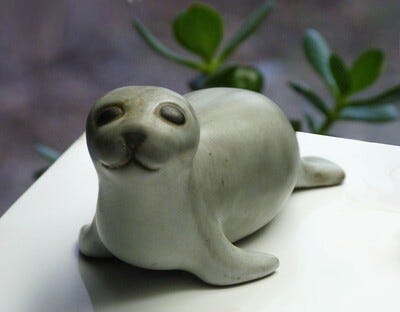
This week I made a Pinterest Pins catalog promoted as a database of Pinterest pins that link directly to a sales page when clicked. Pinterest’s requirements for setting up one’s website according to their specifications are intentionally obtuse. It's a guessing game that I find very annoying, and I did not guess right, so after all the work I did, Pinterest rejected my catalog for unknown reasons.
So on Claude’s advice, I uploaded it myself instead, which Claude said was just about the same thing.
Fortunately, we have AI agents to wade us through the obnoxious Platform behavior.
There is no reason why Pinterest can't explain what it wants in easy-to-understand terms. Pinterest offers no way to have a conversation or ask questions, and no publicly accessible support system; one is just dealing with an icy robot.
I don't understand what the point of all of that is since it is easy to upload one’s catalog through bulk upload on the Pinterest website, which I found out afterward. I can only guess that if the head of the kingdom accepts one’s catalog, one gets better distribution, but the distribution I was getting without intentionally making any effort, before I created the catalog is reported as 47.04K impressions in the last 30 days, up 134% in the same amount of time, Its even higher when I switch specifically to todays stats 47.34k veiws in thirty days -up 143%.
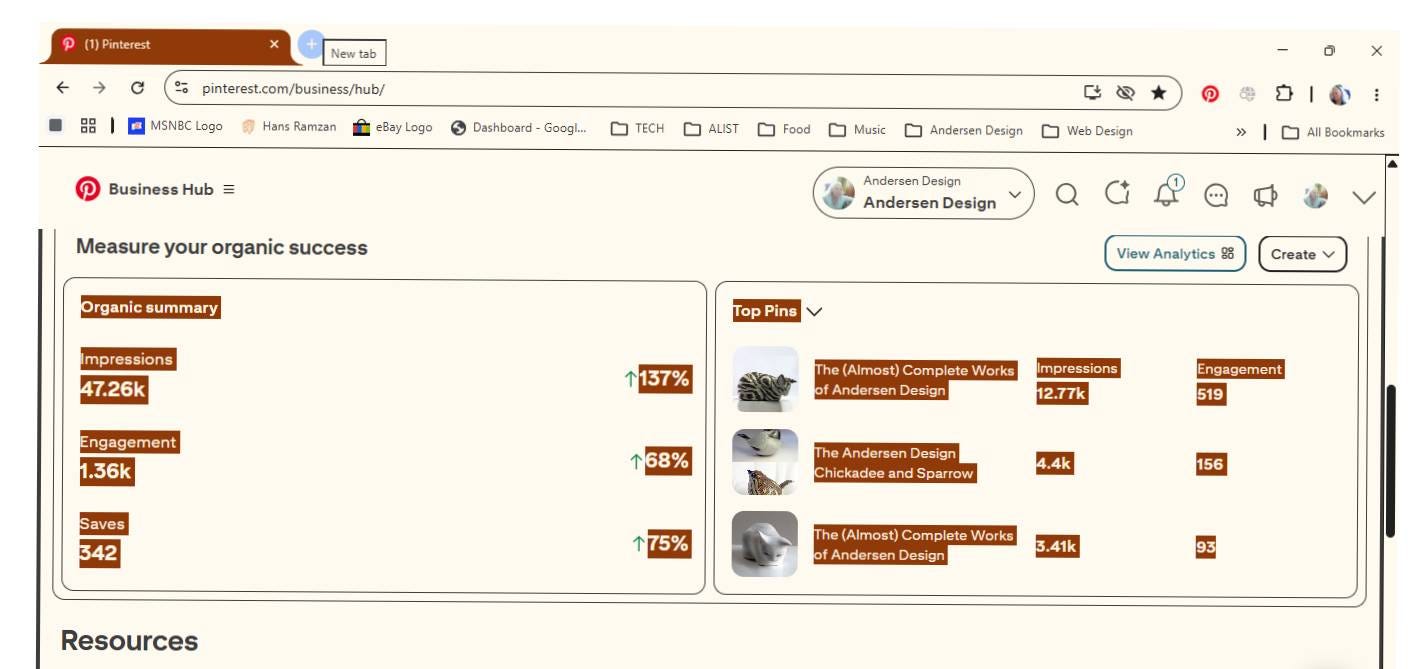
I haven't been trying or paying attention very much to Pinterest. However, it seems that this rapid growth in Pinterest views is the result of creating the Almost Complete Works of Andersen Design. Every pin that is at the top of the performance list has this name, which is the name of the page in the database of Andersen Design's products that I created and published on my website. According to Claude, Pinterest picked up "The (Almost) Complete Works of Andersen Design" page on its own. That database does not connect to sales pages, as it represents the entire line, so I added a link to my store. I first published the Almost Complete Works on 2026/06/28, so it has been published for about 6 weeks.
The SCORE mentor I was working with was very concerned that I should not pursue the Pinterest direction, telling me that it would not work, to give up without even trying, and just accept her prediction that Pinterest does not generate sales, dismissing the fact that the catalog connects Pinterest Pins to my actual sales pages, which I mentioned and she ignored. She advised me to fill out a Google Business Profile instead, which she could write up for me. I don't think the Google Business Profile will generate sales, but she probably needs it for her own plan.
Instead, she wants me to sell all the assets, which I suppose means she will handle the sale and earn a commission. Her business plan is based on constructing a $200,000 facility, and since I am not in the position to do that, my only choice is to sell, as she tells it.
The $200,000 facility sounds like what Andersen Design once had in Portland after the Town would not allow Andersen Design to expand on its own property across the street. No one in the family liked that Portland facility and agreed that smaller studios are a more appropriate environment for producing our line.
Andersen Design wasn’t grown by way of large facilities. This was our first storefront gallery:
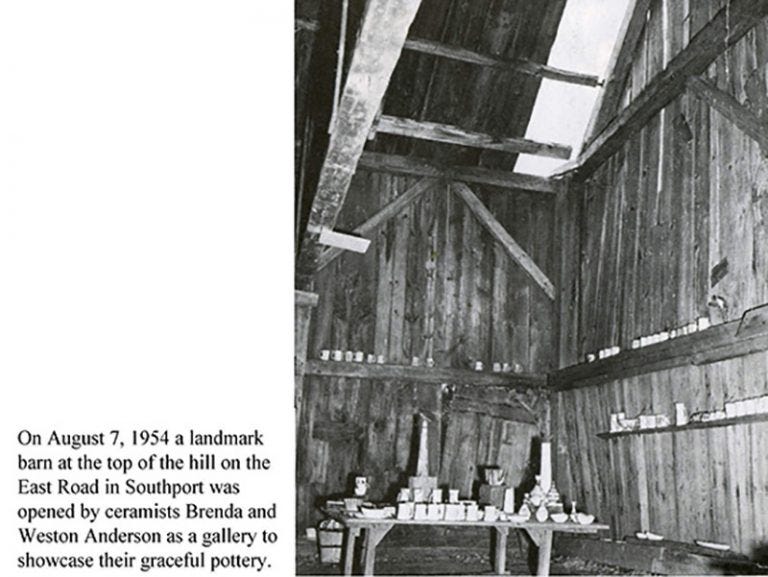
The barn was two hundred years old, located on the side of the road totally outside of any shopping district. Andersen Design succeeded as destination shopping even when it started as a complete unknown, and it made use of affordable structures.
I have experienced before that someone claiming to support what I want to do with the assets very shortly arrives at the plan to sell them, and when I do not want to do that, the helpful person becomes borderline belligerent. What kind of fool am I that I don’t want to sell the assets unless it is to someone who will do the right thing with them? The persons trying to push this idea on me never mention the character or purpose of the hypothetical buyer. I grew up in this business, and so to me it is about preserving the work process and the lifestyle and setting the assets up to enable others to engage in a similar lifestyle.
The work process was always a part of the idea that founded Andersen Design, as in individualizing the decorating process by using the unique character of each artisan’s individual hand, rather than fighting that character and forcing the artisan to conform to an external pattern.
But obviously, it’s easier to find support for selling the assets than it is to set them up so that they can be used by and benefit others involved in the creative process. That is an idea that no one is thinking about- an organically grown community of creative independent makers. That would be a magnet for community identity and economic development- very suitable for the AI era since AI cannot make handmade items.
My Dad didn’t want investors who would tell him how to run the show. He wanted to make ceramics, his way. To preserve the independent lifestyle, he was willing to bootstrap financing, which was as much a part of the work process as was making ceramics.
That is what I want to further. It’s an engaging and meaningful, organically grown grassroots lifestyle- not centrally managed!