
Curious Observations
Why it takes an independent to follow independent paths.


I have been absent from writing this blog while developing a proposal for a column series that would run in newspapers. When I researched grants for investigative journalism, it was hard to find ones that do not require publication and a commitment from the publication to pay the research journalist. Grant info often reads like it is considered exploitative for a research journalist to use a grant to fund their own time and effort. That makes sense in the context of the non-profit world’s volunteer labor force, which frees up funds for acquiring property of all sorts. I spent 19 years researching with only minimal expenses beyond my time and effort, and now I have to get creative about finding other expenses to fund. One well-known Foundation says that they are watching for budget padding, but the system demands it since it is usually stated that one can use some of the funds to cover one’s own work, but that can’t be the entire budget. Put it together, and the reason grants should not be used to fund the author’s time and work is that the author should be working for a publication that pays the author. That also explains why the emphasis is on major publications since smaller publications have smaller budgets.
So, a column that can be distributed through many small publications, dispersing the costs, makes sense and seems appropriate to the theme of heterarchical organization
I wrote an sample introductory post but it was too long and needed to be broken up into three articles to meet the shorter lengths for publications, so I let Claude recreate it as three separate pieces but Claudes perspective only included the information and deleted all the parts that are about the process of doing the research which is a distinctive aspect of the story telling that makes it written by a human as oposed to AI. Claude doesn’t understand this because Claude is AI. I know AI can be programmed to write in the style of famous authors, but that’s not my style.
During this process, my attention shifted to the national legislative archives, where I discovered something very strange. Contemporary laws are organized for the years 1973-2026, and historical records are listed as 1799-1811, 1813-1873, 1951-1972.
Notice the missing years? 1812, 1874-1950.
1812 might be explained by the War of 1812 when the British burned Washington, but how is a 76-year gap explained? It is a period in world history when centralized coordination became authoritarian control. It includes the generation that fought the Great War. Why is the history of those years missing?
Out of curiosity, I googled a known law from the missing time frame, the Bretton Woods Agreements Act, which produced the act on the official Congress website, but in a subfile called “content” as opposed to “bill,” which is the file generally used. At the bottom of the page, it says, “As Amended Through P.L. 118-47, Enacted March 23, 2024.”
The United States Intergovernmental Cooperation Act of 1968 is also in a file called content, but I tried accessing the content file directly, and that was not possible.
The Page Titled About Legislation of the U.S. Congress ignores the missing years without explanation, but provides the link to the Browse directory, which includes the missing years. By selecting All Congresses, I could bring up the 78th Congress (1943-1944), and I used the print function to convert the law to a PDF file, and then used Word to convert it to a searchable text file.
However, that did not work for Joint hearings. I could not discover a way to convert it to a searchable text file from which one can also copy and paste selections of text. The task of reading all of the missing years in the interest of seeking an understanding of why they are deleted from the United States Library of Congress's most generally accessible records is enormous. It would have to be funded as a research project to be reasonably undertaken.
Given the funding world’s attitude toward funding human labor, the consequential thing to do is form an organization and make oneself the executive director. I have observed on nonprofit 990 forms that volunteer labor does not get mentioned at all. Often, the only employee listed is the executive director, who is paid quite well. If one has that position, one could afford to volunteer as a researcher for the organization that has only one employee, the executive director.
One of the screenshots that I saved from the Joint hearings that planned The United States Intergovernmental Cooperation Act of 1968. begins with these words:
Recommendations accomplish little sitting passively on library shelves. The Advisory Commission on Intergovernmental Relations recognizes that its contribution to strengthening the federal system will be measured, at least in part, in terms of its role in fostering improvements in Federal, State, and local relations. Joint Hearing Before the Intergovernmental Relations Subcommitees of 1971s PG 53
The entire Hearing document is 118 pages long. At the top of the document, it is identified as 10-YEAR RECORD OF THE ADVISORY COMMISSION ON INTERGOVERNMENTAL RELATIONS. The Google Books version is readable, but when I tried converting the PDF text with MSWord I received a message that said the “We’re sorry, but the author of this document has set permissions that don’t allow the content to be used in other applications.” I found I could save it as a Word Doc, but the search and edit functions that allow one to copy and paste text do not work, so quoting from the document requires typing it out manually.
However, I was able to convert the 1968 Law to a Word doc, and then I copied some sample text about the definition of a term, “specialized or technical service”, which is very relevant to the current attempt by our federal government to obtain state voting records. If you just call those records a “technical service,” it obscures what is actually taking place:
SPECIALIZED OR TECHNICAL SERVICE
SEC. 108. “Specialized or technical services” means statistical and other studies and compilations, development. projects: technical tests and evaluations, technical information, trammg activities, surveys, reports, documents, and any other similar service functions which any department or agency of the executive branch of the Federal Government is especially equipped and authorized by law to perform.
That is just one section. To fully understand the meaning, it is necessary to read the entire document. The wording in the definition is “which any department or agency of the executive branch of the Federal Government is especially equipped and authorized by law to perform.” Is that a declaration of legal authorization or recognition that the federal government is restricted by what it is authorized by law to perform?
I decided to search for “Specialized or technical services” within the entire Act, but then something stranger happened:
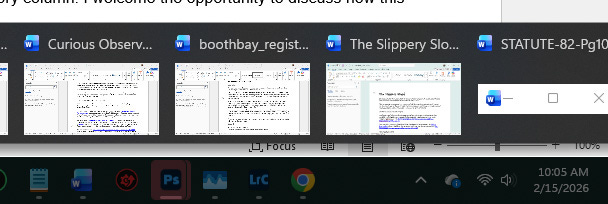
The screenshot shows how my open documents are displayed in Word: The document titled STATUTE-82, which formerly displayed consistently with the others, was displayed in a manner I had never seen before. When I clicked on it, a different document (one of my own) opened.
I went back to the PDF version and opened it in Word again to receive this message:
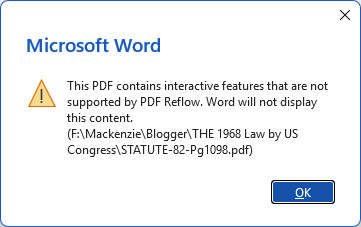
I clicked OK and, this time, saved it to a unique name. That stabilized it, Afterward I could also open the doc with its original name normally.
My curiosity has been aroused. Why are some years of legislation missing in the Library of Congress's most accessible records?