
Maine's 1969 Constitutional Response to Federal Overreach
Examining Maine's economic policy and constitutional erosion corresponding since the USA went off the gold standard in 1971

A few days ago, I had to schedule a ride via AI. I converse with AI as I would with a human. AI responds like a broken record by repeating the same series of words over and over. When I am transferred to a human agent, I learn that AI had scheduled a pick-up trip five times, but no return trip.
A couple of days later, I scheduled another ride. This time, AI abruptly stops talking mid-sentence and announces that it is going to transfer me to its colleague (human agent). Perhaps my information is now in AI’s database with a note attached that AI should immediately forward me to a human agent to avoid an AI mental breakdown.
Imagine a world where humans are sorted into two categories- well-behaved humans who respond to AI strictly as directed, and AI outliers who are immediately transferred to human agents to maintain AI’s productivity and efficiency.
My tip of the day for speeding up the process of getting past the AI gatekeepers to a human agent, is to talk to AI as if you are allready talking to a human. You might try throwing in some intentionally off-topic responses to what AI asks, and before you know it, you might find yourself being transferred to a human before AI even gets to recite its redundant list of irrelevant things, and that will increase your speed, productivity, and efficiency!
Even stranger things, thanks to Donald Trump, now is the most opportune moment to publish my work, Public Private Relationships and the New Owners of the Means of Production, which has lain dormant for ten years. The book documents the systemic corruption by the centralized economy of Maine’s constitutional government. No wonder I can’t find support for it! Its subject is the constitutional corruption embedded in the system that is maintained by everyone looking the other way, and kept under control by the redistribution of wealth.
As my research discovered, the Maine centralized economy was closely preceded by the enactment of The United States Intergovernmental Cooperation Act of 1968.
Previous to discovering this act by happenstance, I had not heard about it. As it struck me, the most prominen aspect of the act is that it authorizes the federal government to write state legislation “at all levels” of government and suggests that the state’s should change their constitutions to be consistent with this federal law, enacted by the same federal government three years before the USA went off the gold standard, and establishing the system through which the federal government will distribute wealth to the states.
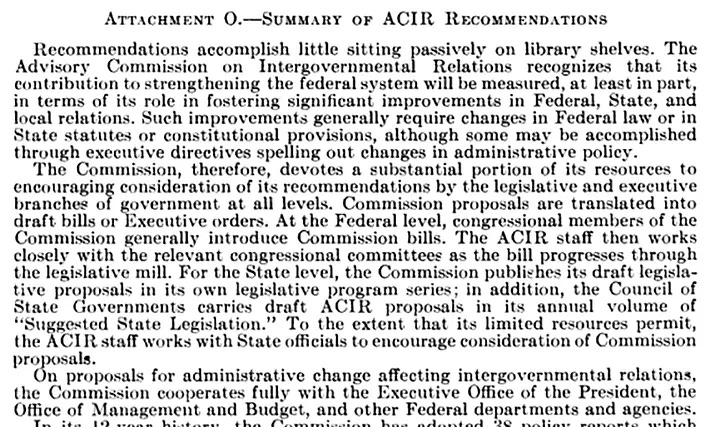
An AI search for the law produced three results Lyndon B Johnson Remarks Upon Signing the Intergovernmental Cooperation Act, and two very similar documents Circular No. A-97 and Intergovernmental Cooperation-GQ Online Edition
The documents provide a lot of information about what is in the act, but I have not been able to locate a link to the actual act of legislation. I do not recall what path I was following when I found a link to an image of the full enactment quite by accident. My AI search did not produce a repeal of the act, and there is no reason to believe that it has been repealed. A probable explanation for why I stumbled across this act is that I am an independent researcher operating outside of the institutional system. So I follow a uniquely different path.
The Remarks by Lyndon B Johnson reveal that the Act was introduced by Maine Senator Muskie, among others, and describes the Act by leading with the redistribution of wealth to the states:
The Intergovernmental Cooperation Act is the fruit of such labor. It will bring:
--simplified and more flexible administration of hundreds of Federal grants to the States;
--better information to Governors and State legislators concerning these grants;
--improved regional and local planning;
--new ways for Federal agencies to share their special skills and knowledge with State and local governments.
There is no mention of what is central in the act - that the federal government will be in charge of writing legislation at all levels of government.
I asked AI if newspaper articles had been written about the United States Intergovernmental Cooperation Act of 1968. AI confirmed that articles had been written, but on request for specific articles, produced one result, which is not a newspaper article but Senator Muskies Congressional Record at Bates College, leading to the conclusion that this significant and transformational act was barely covered by the media.
Today, we are living through the late-stage of the federal wealth redistribution system, while it is self-destructing. The man engineering the destruction is described by many as the most corrupt American president ever. Trump’s former White House lawyer, Ty Cobb recently said he doesn’t think there is anybody outside of the United States who considers Trump to be sane.
This is an unprecedented, earth-shattering watershed moment in the history of our country, when our nation is like the driver of a car struggling to keep the car on its path as it goes around a curve on an icy road. The tracks that we are trying to maintain are the rule of law governed by constitutional principles.
As I am preparing an application to apply for a grant based on the first chapter of my book, the news is moving at a rapid pace, making my investigation more significant by the hour. Donald Trump is deconstructing everything from the global world order to the American government and its buildings, and even going so far as to ban the use of paper straws. The administration is systematically targeting blue cities for invasion by its own military forces, executing its own personal civil war in America. How that evolves remains to be seen. Everyone is called to take a stand, including members of the military, many of whom did not foresee that their orders would include attacking and imprisoning fellow Americans.
There is no better time than now for Americans to become more conscientious about their Constitution. The system that is being deconstructed will have to be reconstructed. Maine law says that the Maine and Us Constitutions are supposed to be taught in our public school system, but I have not heard of that occurring. I asked AI for specific courses and received an elusive answer, and it asked for a specific location, the Boothbay Region. AI provided another generalized answer, and this link to AOS98 where I would find the information, but I do not see a mention of constitutional studies on the AOS website, and I have never heard such studies mentioned in the long conversations that have been occurring about our public educational system.
Ten years ago, I wrote the first draft of a book about the erosion of constitutional law, replaced by central management, and I have continued that research ever since. It has been 16 years during which I have been researching the statutes and opining about the Constitution.
I could not attempt the second draft of the book as it felt like an overwhelming, time-consuming, and intimidating project. Being paid would make the job easier to do, as would working with others, but currently it’s just me. No one else that I know about is talking about the Maine Constitution. Will the clear and present danger to the continued existence of our federal Constitution reach down to the very roots of American society and cause citizens to give equal consideration to the state of their State Constitutions in relationship to state statutory law?
I can apply for a seed grant of up to $2500.00 without references and publishing commitments, but the board will not consider my proposal for the $10,000.00 regular grant if I do not have references and commitments from publications. I sent a letter to four Maine publications and four national publications and received the usual response- none whatsoever. So it is unlikely that I will be able to apply for the regular grant.
I watched the How to Apply for a Grant video on the website. At the very end, the presenters say they love proposals having to do with the law, which is what my research is all about, seen through the eyes of a layperson without a law degree and outside of institutionalized frameworks, the same frameworks that are tumbling down amid the wreckage of the USA, wrought by the insane leader at the top of the power pyramid, or so he imagines, not understanding that the USA is not designed as a hierarchial structure.
Torches lit up a mountain slope over Davos, welcoming Donald Trump to the World Economic Forum by spelling out “No Kings”. As an organiser explained, “Thanks to our ancestors, we overcame kings. Today, as autocracy and imperialism are rising again, we want to send a message to the powerful in support of democracy and international law.”
The world is sounding the alarm. The old order is no more. There is talk of going back to the gold standard, and that is where my project begins, just three years before the US adopted fiat currency, there was the The United States Intergovernmental Cooperation Act of 1968, suggesting coordinated implementation of the wealth redistribution system. Now, as talk of returning to the gold standard coincides with dismantling federal alliances and economic structures, understanding how the 1968-1976 architecture was built and how it overrode constitutional protections can provide historical context for what may be unfolding today.
In this moment, our focus is on the rapidly unfolding destruction of all we took for granted, but after the system collapses, if it collapses, we will still be here, and it will be time to reconstruct, which can’t happen without a rule of law, which, if we succeed, we will still have in our Constitution. It is not the Constitution that is the problem. It is the character of the culture that allowed our Constitution to be supplanted by the interests of the centrally managed economy. That still leaves us dealing with all the damage Trump has done and the pre-existing system in shambles.
My seed grant project asks if there was a direct cause and effect between the United States Intergovernmental Cooperation Act of 1968. and Maine becoming a constitutional Home Rule state in the following year, 1969.
My plan is to examine the proceedings of Maine’s Second Constitutional Commission (1963) and related legislative records through the Maine Legislative Library. I will also use newspaper archives to research across multiple Maine publications, including the Portland Press Herald, Bangor Daily News, and regional papers, looking for the public debate, grassroots organizing, and regional perspectives. I will travel to Augusta to access non-digitized Constitutional Commission reports held at the Maine Legislative Library’s offsite storage facility.
The long-term plan includes completing the book I wrote ten years ago, but each chapter can also be a stand-alone article that can be published as a series and be the subject of a seed grant. This idea is similar in concept to the idea of the video series, which will present core ideas in short sound bites.
Making a video series is a more complex process than writing a newsletter. Still, the thing that keeps me going is knowing that it is the most relevant thing I can do as we live through the attempted transformation of our federal government, with our state governments being only a few steps behind.
Thankfully, our state government is resisting the federal government takeover, even as the state of Maine enacts aggressive policies to complete the long-standing incremental plan to eliminate Maine constitutional Home Rule and replace it with the centrally managed state, as seen in the recent state grab over municipal ordinances. in HP 1489 and follow-up enactments.
It took about a week to produce a reel that expresses a thought that I can write in under an hour, but a reel can reach a larger audience because a reel requires less time to absorb than reading a blog or a book. The process of creating a video is mechanical compared to the organic process of writing a newsletter. Writing is an unobstructed process of discovery. Creating a reel is also a process of discovering, intersected with many mechanical processes. That might be a reason to employ an AI App, but at the same time, the AI App might eliminate the process of discovery that is embedded in the mechanical process of creating a video.
The end goal of the reel is to communicate simple soundbites and string them together as a series into a historical narrative that communicates the essence of the history I have been researching, outside of the institutional mainstream for decades. Now is the time to tell the story.
There is much made about AI’s production speed. My process was laborious and confusing, but that is where the discovery process dwells. It is confusing because when commencing on a journey of discovery, there is no clear concept of where it is leading. Confusion is an unknown process unfolding, requiring engagement to sort it out. Confusion is time-consuming, but the results are different than if you follow a workflow laid out step by step in advance, not to say there is no step-by-step workflow conceptualized at the outset, but the process of discovery revolutionizes preconceptions.
The reconstruction of the USA requires human input, not to be dictated by the leaders of big tech companies who will deliver the dystopian plan. We need the new “human plan”. What will it be?