When the Maine Legislature Devised a Clever Run Around of the Maine Constitution
And other musings about our contemporary reality


I read an article on Medium titled I Didn’t Write a Single Article… Yet I Made Over $7,000 Using This AI- or rather, I skimmed it to find out what it was selling, which is an AI tool that does everything for you, from writing the articles to promoting them, and for a small fee, and a minor amount of editing work, one can just sit back and let the money roll in, so it says.
The only thing you need to accept is that you are useless and what you have to say is worthless. This repeats the dilemma that those who remain employed at the corporate headquarters complain about. The industry that used to be so dependent on the creativity of the workers that academia invented the concept of psychological ownership to encourage workers to make their creativity available for corporate ownership has now reduced the worker to the overseer of AI, which does the essential creative work.
The Real Threat Isn’t AI. It’s That Our Jobs Were Never Worth Doing.
I kept on digging… and while researching that piece, I discovered something more disturbing: we’re not just failing to train the next generation of developers. We’re actively ghettoizing the current generation of senior developers, trapping them in roles that transform them from craftsmen into machine supervisors. It’s a pattern as old as industrialization itself, and we’re repeating it with digital precision. The Senior Developer Ghetto: How We Created a Glass Ceiling Made of AI & Legacy Code
The problem remains that the workers have been spoiled into believing their jobs can be creative, and some of them quit to become solopreneurs where they are marketed apps promising that AI can do the creativity for the entrepreneur, and the human just has to edit, review, and watch the money roll into their bank account.
This misses the same point the the Governor’s Council of 1976 missed about the small business economy- the quiet part that never gets spoken out loud at central management headquarters- it isn’t just about the money- it’s about meaningful engagement in a work process too.
I designed my own website using AI as my technical assistant. AI didn’t do the creative part, but I do not make a living from my website. In theory, I can buy an AI tool and let AI set up a website that produces an income, and I can continue to do my own work unpaid while AI does the income-producing work. AI does it all except a few choices made by me, so I just have to pick a money-making subject like “How to make $1000.00 a day without working!”
So will the world bifurcate into the money-making world of what is produced by AI and the other world, where the function of work is meaningful engagement, that continues behind the scenes?
I looked up the hot money-makers, and I decided, as long as I am doing this, I can choose a topic that I want to learn more about, like Digital Marketing: SEO, social media strategy, email marketing, and content creation.
Allready I am going off script and trying to make money-making meaningful!
In theory, AI can run ads for me. How would AI create an ad for the Andersen Design website? or my e-commerce website AndersenStudio
So I asked Claude to advise me on free AI Ad apps.
Outrageous! AI is asking me to create my own heading and subheading! I thought it was going to do this for me! Now I have to figure out what I am advertising myself! This constitutes false advertising by an advertising agent!
I asked ChatGPT to do the ad for me, and it created an image of the production space , looking over the Mill Pond, the exact location where my parents wanted to build, across the street from our house, but the Town would not allow it, and thereafter, my parents sold the property to the Land Trust.
However, the ChatCPT ad shows people throwing ceramics, not making ceramics in molds. When I explained this to ChatGPT and provided images of our now-demolished home and studio, ChatGPT said I had to purchase the Pro version, and so I decided to move on to Canva.
Then I returned to the video project, which takes a lot more time and effort than writing a newsletter does, but I thought it was because it is a new process, and if I concentrate, I could make my work flow more efficiently, and it would not take so much time.
However, as I was doing so, I realized a very important aspect that I had not seen previously when I was writing the chapter, and that one aspect became the point of my next video. I thought I would have completed the second video by now. Instead, I realized it is worth the time and effort to get it right. Editing requires going over a sequence many times, and if I hadn’t been doing that, I would not have realized the point of my next video. The editing process is what brought it into view.
The point is about the language used to charter three former military bases in Maine into state-controlled development corporations. This includes the Midcoast Regional Development Authority. The language used in the statute is that the base is “a municipal corporation,” but the title of the statute is “The Washington County Development Authority,” -Not the Washington County Development Corporation.
What is the reason for the base being an Authority by title and a municipal corporation by definition?”
Look to the Federal Base Closure Rules and the Maine Constitution for the answer. The Base Closure Rules grant priority, not to the state, but to local economic development organizations. As I reported on my first video, the state arranged to have the federal government requirement changed for Maine
However, in all cases, the state swooped in to change the rules, brush local authorities aside, and take over the property. To satisfy base closure rules, it has to be formed as a general development corporation and not a municipality. If it were a true municipal corporation, then the property would be transferred to a local authority and not a state authority.
However, the Maine Constitution prohibits the Legislature from chartering corporations with an exception for municipal purposes, which I submit is because municipal charters cannot charter themselves since the municipal corporation does not exist until it is chartered, and so it needs an external authority to enact the charter, which is the State Legislature.
Article IV.
Part Third.
Legislative Power.
Section 13. Special legislation. The Legislature shall, from time to time, provide, as far as practicable, by general laws, for all matters usually appertaining to special or private legislation.
Section 14. Corporations, formed under general laws. Corporations shall be formed under general laws, and shall not be created by special Acts of the Legislature, except for municipal purposes, and in cases where the objects of the corporation cannot otherwise be attained; and, however formed, they shall forever be subject to the general laws of the State.
Since the Maine Constitution prohibits the Maine Legislature from chartering corporations by special act of legislation, it’s best not to call the charter a corporation. Call it an Authority, by title, and by definition categorise it as a “municipal corporation serving as an instrument of the state.”
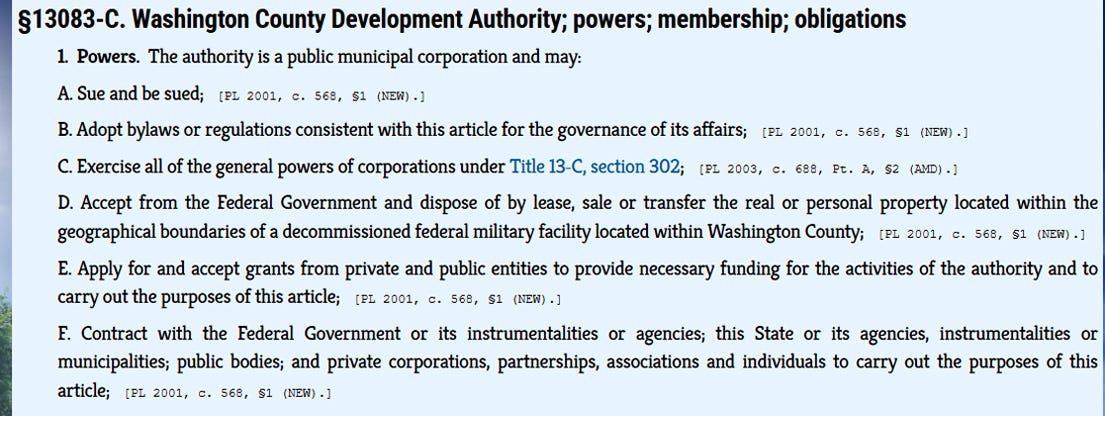
However, the statute then goes on to give the “Authority” all of the powers associated with general corporations:
§13083-C. Washington County Development Authority; powers; membership; obligations
1. Powers. The authority is a public municipal corporation and may:
A. Sue and be sued; [PL 2001, c. 568, §1 (NEW).]
B. Adopt bylaws or regulations consistent with this article for the governance of its affairs; [PL 2001, c. 568, §1 (NEW).]
C. Exercise all of the general powers of corporations under Title 13‑C, section 302; [PL 2003, c. 688, Pt. A, §2 (AMD).]
But there is a caveat. The statute does not grant the powers that are unique to a municipal corporation, which is municipal government, and voting referrendums in which the inhabitants of the municipality have a say on what goes on, and the power to collect property taxes, so the “Authority” is a “municipal corporation” in name only and the only reason for doing that, that this author can see, is to effect a runaround of the Maine Constitution, Article IV, Part Third, Section14.
Although the Maine Constitution prohibits the legislature from chartering corporations with an exception for municipal corporations, I could not locate a definition for a municipal corporation in the Maine Statutes. I submit that this definition is simple to write. It is partially recognized in Home Rule, which provides for a public referendum on bonds. Just say it includes all the powers of a corporation as described in other statutes, but it includes the power to collect property taxes and requires public referrendums on electing Town leaders and on municipal bonds. These seem to be the fundamental characteristics that distinguish a municipal corporation from a general corporation, but the Development Authorities chartered by the Maine Legislature lack this authority for said functions, so if such a definition were added to the Maine Statutes, that would be a spanner in the works.
However, there doesn’t seem to be any other explanation for why the municipal authority is chartered as a municipal corporation that serves as an instrument of the state, as opposed to a Development Authority (corporation) that serves as an instrument of the state, other than that the latter is constitutionally prohibited in Maine.
It is not an anomaly that the Maine Legislature writes statutes with the intent to get around the Maine Constitution by carefully crafting the language. That is what the video series will show to be a historical pattern.
We can only imagine what Maine would be like if it actually followed its Constitution, and we should imagine that. The video series will also present the vision of an alternate Maine that functions as a heterarchy consistent with its Constitution, instead of a hierarchy
Section 14 was added tothe Maine Constitution in 1876. Today, the situation is as bad, if not more extreme than, what Governor Seldon OConner described in his inaugural address.
Governor Seldon Connor’s Speech
Section thirteen presents a discretionary field of action which your own honor will impel you to occupy to the fullest extent. ‘The title of ‘Special and Private Laws,’ which includes so large a portion of the laws of former Legislatures, is an obnoxious one, conveying suggestions of privilege, favouritism and monopoly; though happily these evils have not in fact, stained the character of our legislation, they should not be suffered to have, even in the form of our laws, any grounds of suspicion that can be removed. Other weighty objections to special laws for private benefit are, that they are obtained at the public expense, and in their passage distract the attention of legislators from matters of public interest. The opportunity is now afforded, and the duty enjoined upon you, by the amendment, to restrict the necessity for such laws to the narrowest possible limits. An analysis and classification of the private and special laws upon the statute books, will inform you of the objects or which it is desirable to provide by general laws, if practicable. ‘Many objects have been hitherto specially legislated upon although they were amply provided for by general laws. I have distinguished authority for the statement that sixty or more of the corporations created by a special act for each, by the last Legislature, could have been created and organized under general laws. The reason why the general laws have not been resorted to a greater extent, is not, so far as I am informed, to be found in any insufficiency or defect of those laws, but in the greater ease and simplicity of the method of application to the Legislature and in the fancied higher sanction of an authority proceeding directly from it. Section fourteen, relating to corporations is compressive and peremptory. It relates to all corporations, except only those for municipal purposes. It clearly prohibits their creation by special acts if the objects desired can be secured under existing general laws.’ From Governor Seldon Conner’s Inaugural Address 1876
This speech should be in the video series, but requires a male voice to deliver it. I am putting out the call. It would be great to do it theatrically filmed in period costume.
Anyone can try it on their own. I am using Audacity and Davinci Resolve- both free. This would be an exciting and very relevant project to do as a group effort. Imagine if we could effect a change toward what the Maine Constitution, through the people’s vote, intended Maine to be. That would be worth doing.